
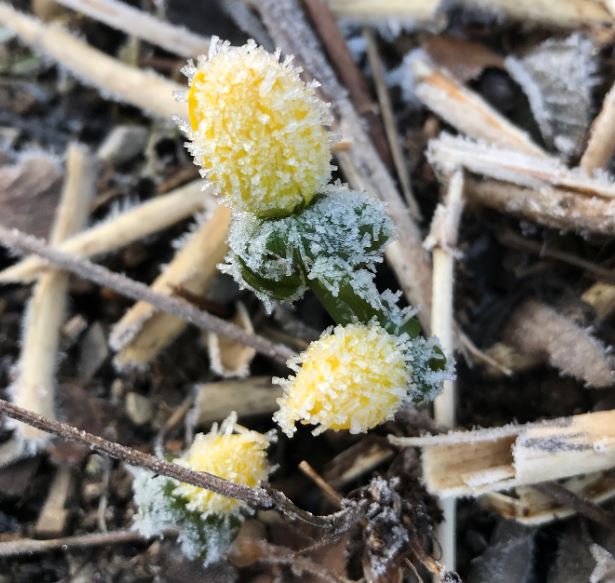
 The bright yellow winter aconite provides welcome colour to British gardens early in the year. Winter aconite blooms as early as January, and grows en masse under trees. Did you know that the 18th-century fashion for landscape gardens brought the little plant into fashion?
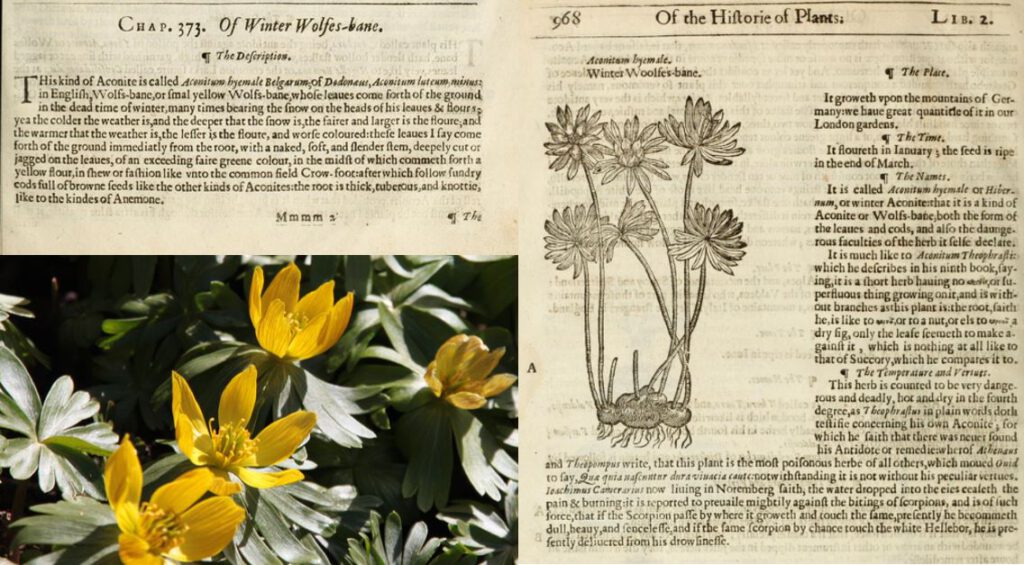
Winter aconite is native to South Eastern Europe. It was introduced to Britain in 1596. An early recording can be found in “A Catalogue of Plants Cultivated in the Garden of John Gerard, in the Years 1596–1599“. Gerard also describes the plant as follows: “whole leaves come forth of the ground in the dead time of winter, many times bearing the snow on the heads of his leaves and flowers”. The flower was then also known as Winter Wolfes-bane.
Colour for the new, natural-looking landscape garden
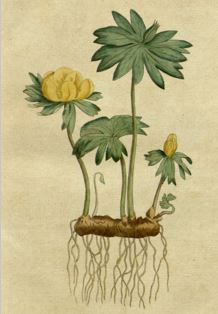
The winter aconite began its career as a plant for the parklands of the aristocracy, cultivated in the gardens of botanists. As expansive landscape gardens grew in popularity, the flower with its bright yellow bloom came into fashion.
Lancelot Brown (1716–1783), the leading landscape architect of his day, brought an end to the previously dominant French formal garden with its geometric parterres through his work. In its place, he created sweeping lawns, seemingly endless vistas, tranquil lakes and meandering paths. Free-ranging sheep and herds of deer also fitted well into his concept. Everything was intended to look natural and idyllic — even if achieving this ‘naturalness’ required the movement of vast quantities of earth and, on occasion, the relocation of an entire village.
Naturally, flowers also had their place in these new landscape gardens. Brown planted winter aconites so that even in the barren early months of the year there would be something of interest to see in the parklands. One of the pioneers of the winter aconite trend was the country estate of Croome Court.
The popularity of the winter aconite as a plant for parkland was probably also due to the fact that it is resistant to deer and rodents. All parts of the winter aconite are highly toxic, even to animals.
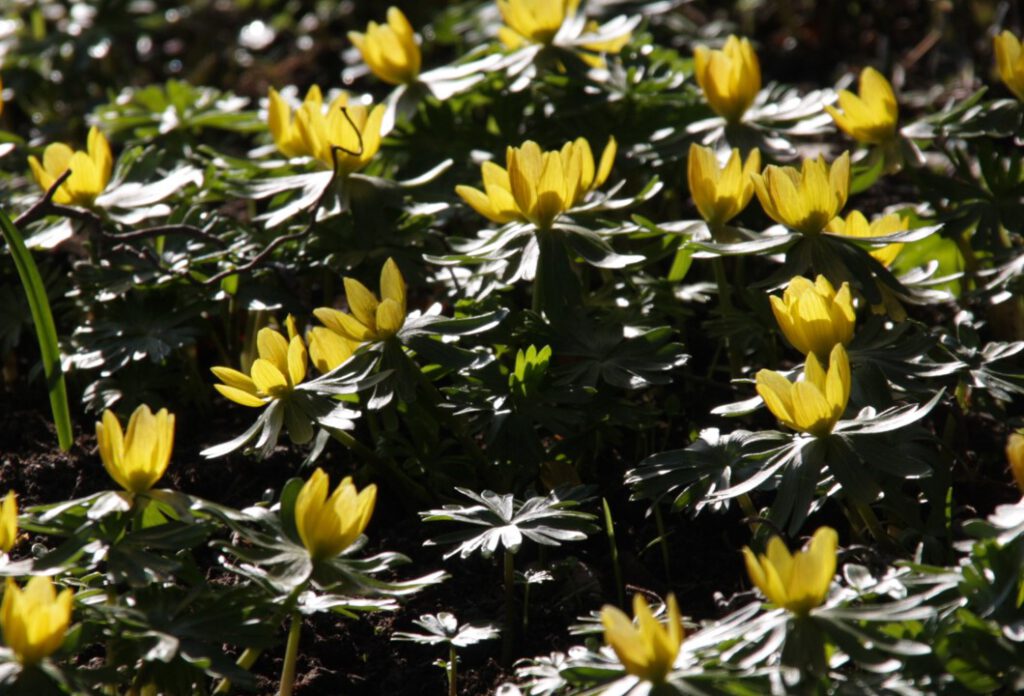
Before long, the winter aconite escaped from the landscape gardens into the wild: in 1838 it was first recorded as flowering in the wild in Great Britain. Today, many people regard the winter aconite as a native plant that heralds the approach of spring.
A Scientific approach in 1807 provides the plant with a new Latin name
Historically, winter aconite was identified with the classical aconite, a poisonous herb dedicated to Hecate, a moon goddess in Greek mythology teaching witchcraft and sorcery.
A scientific description was first achieved by botanist Richard Anthony Salisbury. He published his research in 1807 in “Transactions of the Linnean Society of London, Volume 8” (https://archive.org/details/mobot31753002433545/page/300/mode/2up). The plant became known by the new Latin name Eranthis hyemalis (L.) Salisb.
Related articles
Source
- The herball, or, Generall historie of plantes by John Gerard, 1636: https://archive.org/stream/herballorgeneral00gera#page/966/mode/2up
- A Catalogue of Plants Cultivated in the Garden of John Gerard, in the Years 1596–1599: https://www.biodiversitylibrary.org/item/30619#page/26/mode/1up
- Transactions of the Linnean Society, 1807, Volume 8: https://archive.org/details/mobot31753002433545/page/300/mode/2up
- An Historical and Descriptive Account of Croome D’Abitot, the Seat of the Right Honourable The Earl of Coventry by William Dean (gardener); Worcester, 1824
Article by Anna M. Thane, author of the novel
“Von tadellosem Ruf” (http://amzn.to/2TXvrez)