An elegant simplicity and informality characterised fashion during the 1770s and 1780s. The robe à l’anglaise became the most popular dress for ladies. However, the most fashionable women also drew inspiration from foreign styles, menswear, and even working-class clothing.
What is a robe à l’anglaise?
The robe à l’anglaise had been worn in Britain for decades. It gradually supplanted the robe à la française, which had been a cornerstone of fashionable dress since the 1740s.
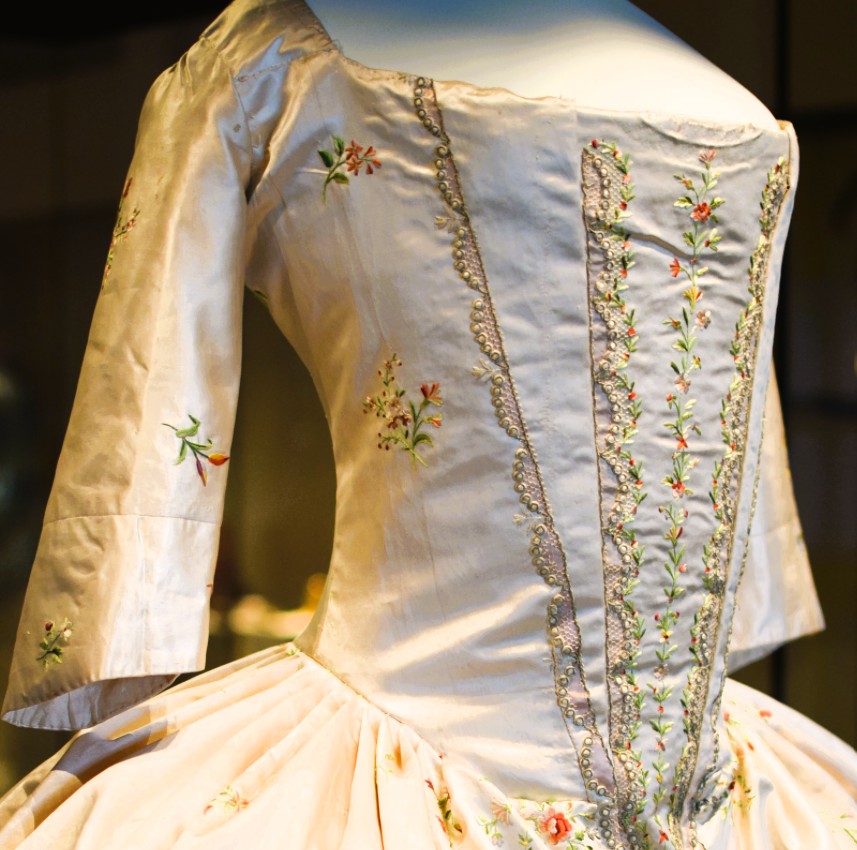
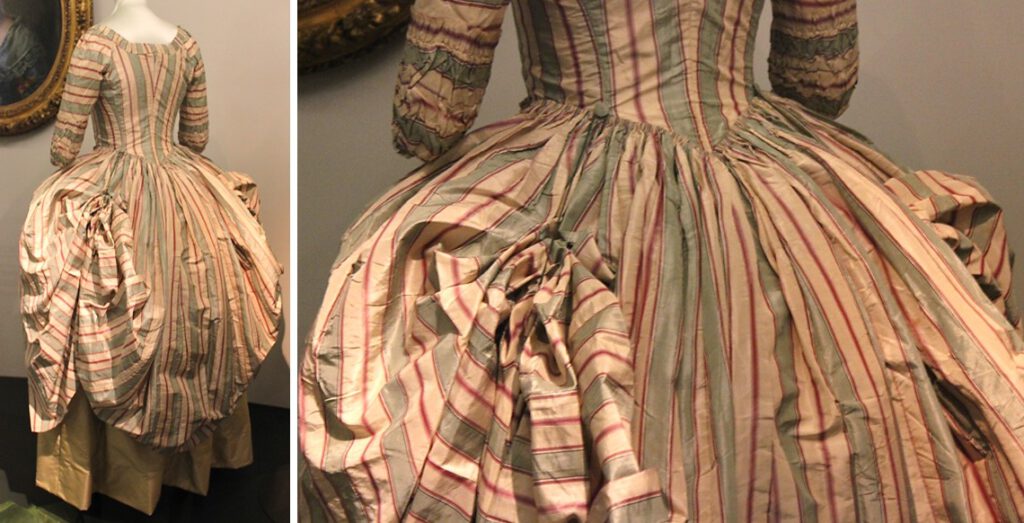
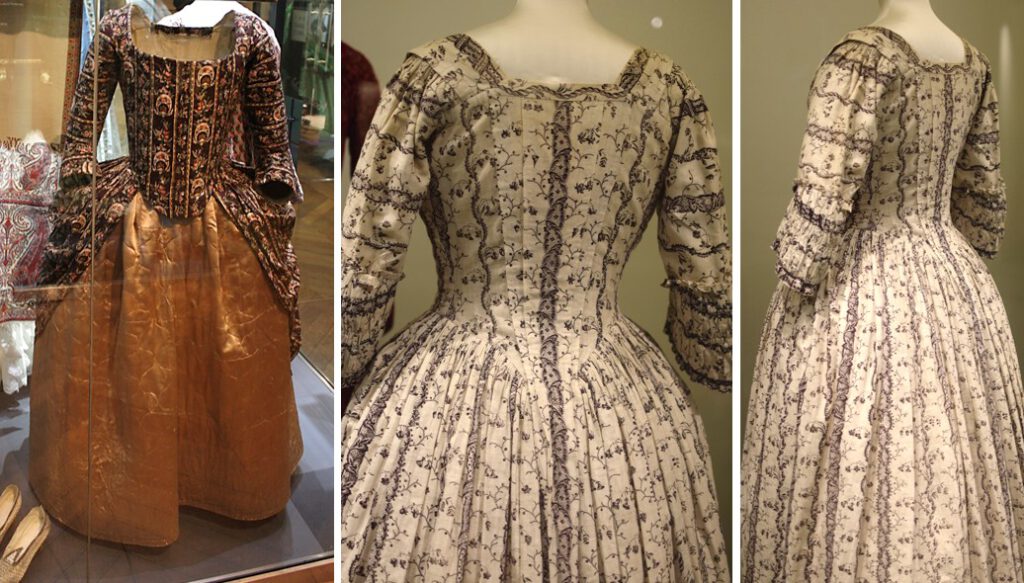
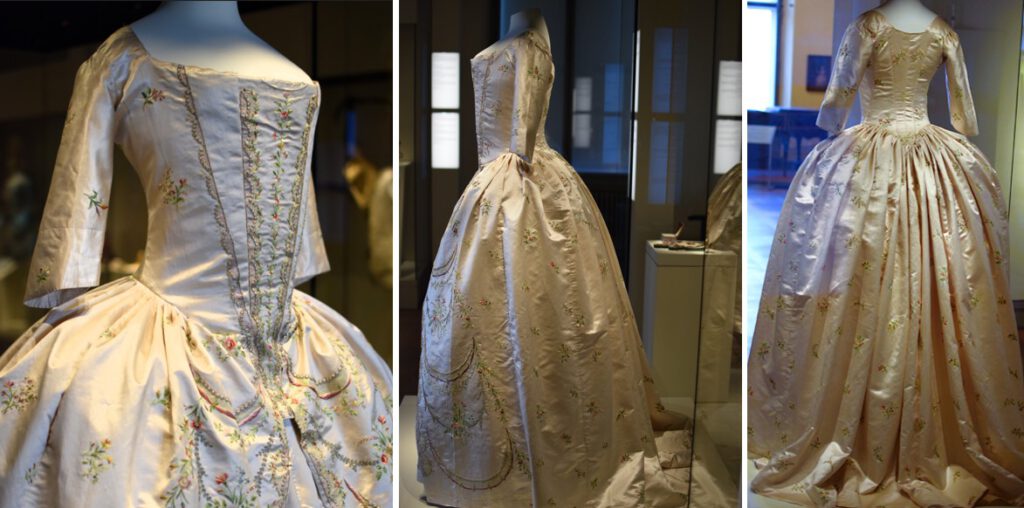
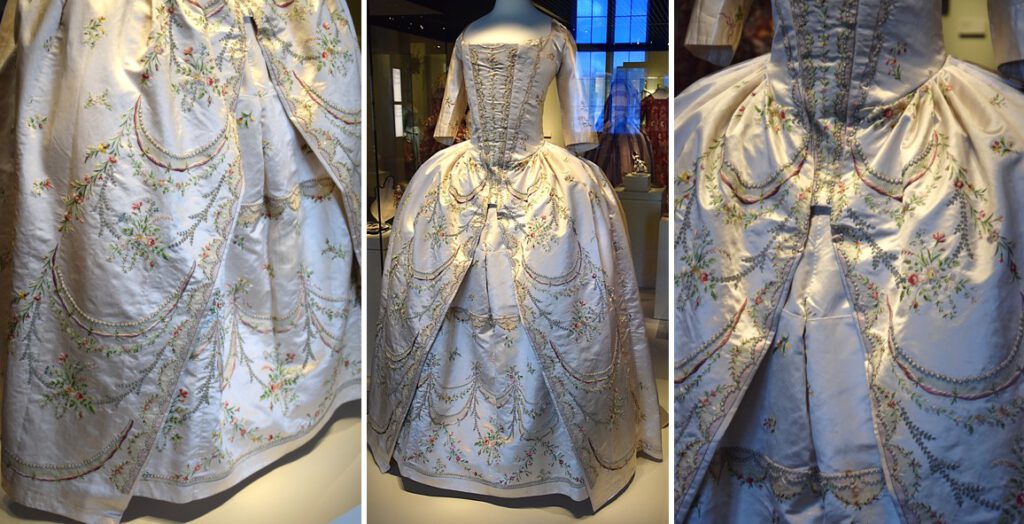
The robe à l’anglaise was a fitted gown worn over a matching or contrasting petticoat. The back pleats were sewn down to fit closely to the body before being released into the skirt. The skirt itself could be draped in a variety of ways. By the 1780s, bodice and skirt were cut separately. The large hoop of previous decades was replaced by smaller paniers or hip pads. Ladies continued to wear boned corset, or stays, under the dress. The robe à l’anglaise had so called “sabot sleeves”: narrow, curved at the elbow, and ending in a ruched cuff made from self-fabric, muslin, or gauze.
The robe à la française, which had previously dominated fashion, continued to be worn for formal occasions. Wearing a hoop remained indispensable for court dress.
New influences in women’s dress
With a growing taste for informality and simplicity, women adopted styles previously worn by the working and middle classes, explored so-called “Oriental” fashions, and even borrowed elements from menswear.
- Caracos were originally working-class jackets. Thigh-length and open at the front, they were worn with a petticoat. Initially adopted by aristocratic women as informal housewear or for country pursuits, the caraco-and-petticoat ensemble became fashionable daywear in urban settings during the 1770s. These garments were typically made from lightweight silks or printed cottons.
- The robe à la polonaise (or also robe retroussée), inspired by Polish national dress, was popular from the mid-1770s to the mid-1780s. It was a two-piece gown with a cutaway, draped, and swagged overskirt worn over an underskirt or petticoat. Its distinctive swags were created by looping up the skirt with internal ribbons or cords. Petticoats were often ankle-length, making the style practical for walking as the skirts did not trail on the ground.
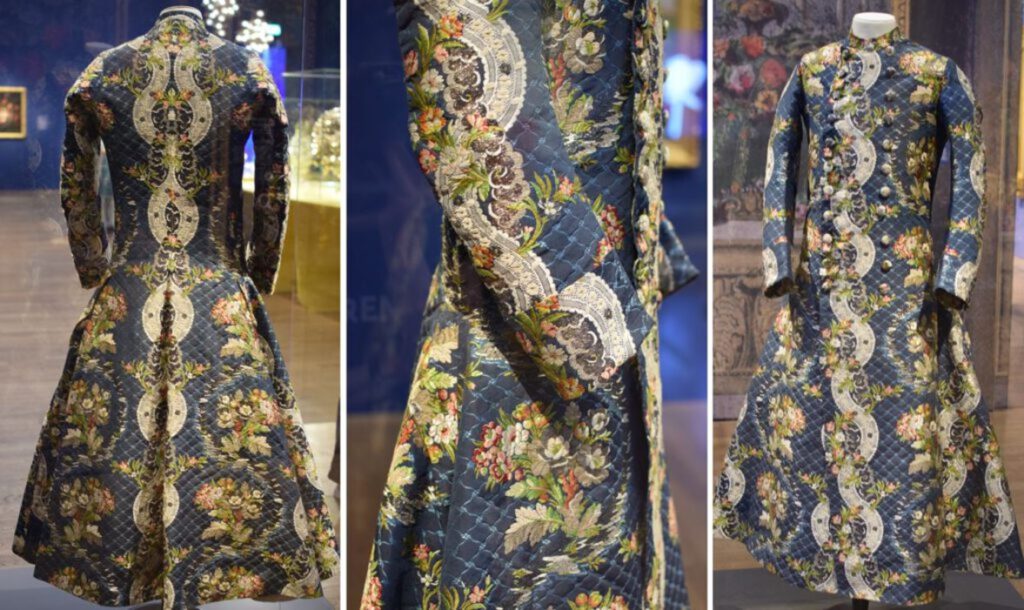
- From the masculine wardrobe came the redingote, most popularfrom the late 1770s through the 1780s. It was a coat-dress with a high collar, pronounced lapels, and double-breasted front. Some variations even echoed military uniforms, adorned with parallel rows of horizontal braid, yet the look remained feminine when paired with accessories such as flamboyant hats and delicate shoes.
- Other informal and more experimental styles included the lévite and the circassienne. Such fashions often gained popularity through theatre and opera productions inspired by the East. The lévite was a wrap gown tied at the waist with a sash, while the circassienne featured short, fur-trimmed sleeves and decorative tassels.
Fabrics and design
Simpler dress styles encouraged the use of lighter fabrics.
- Silks became both lighter in weight and simpler in design. In the early 1770s, motifs became smaller, and vertical elements gave way to arrangements of broad and narrow stripes. By the mid-1770s, stripes had become regular in width.
- Plain and printed cottons, as well as linen garments, grew increasingly popular following the repeal of the Calico Acts in 1774, which had previously restricted the import and sale of cotton textiles to Britain.
- Women of all classes wore white cotton chemises in the 1780s. The chemise à la reine, a simple muslin dress popularised by Marie Antoinette in 1783, became an essential item of fashionable dress.
Finishing Touches: Accessories and Hair
- The fichu, a triangular shawl draped over the shoulders and fastened at the front, replaced the handkerchief.
- Large muffs were fashionable during the 1780s.
- Women’s hairstyles reached extravagant heights in the 1770s, adorned with flowers, fruit, ribbons, feathers, and even model ships (though whether Marie-Antoinette really wore the wig “la belle poule” with a model ship to commemorate the fight of Belle Poule and Arethusa of 17 June 1778 has not been proven).
- By the 1780s, these towering styles fell out of fashion. Hair was instead worn full and softly puffed, achieved with the help of false hair, powder, and pomatum.
- To complement these voluminous hairstyles, hats and bonnets became larger and more elaborately decorated.
And for the Gentlemen?
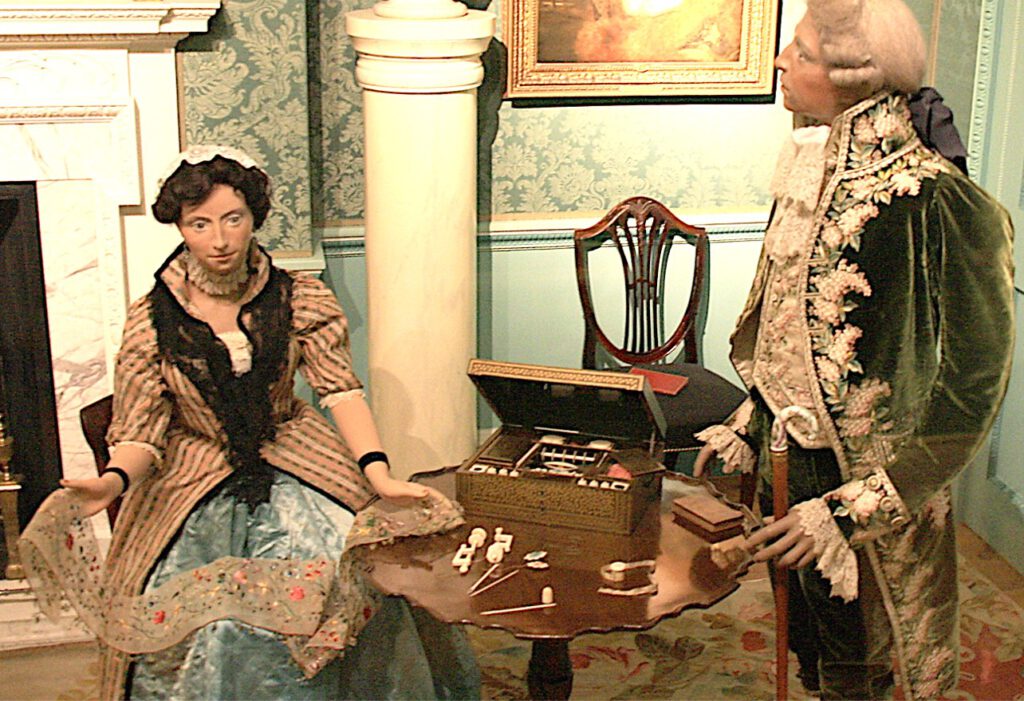
British style strongly influenced men’s fashion during the 1770s and 1780s. As the trend towards simplicity and informality gathered pace, the attire of the English country gentleman was widely adopted—even by fashionable young Frenchmen, albeit in more flamboyant colours and patterns than the original models would have considered appropriate.
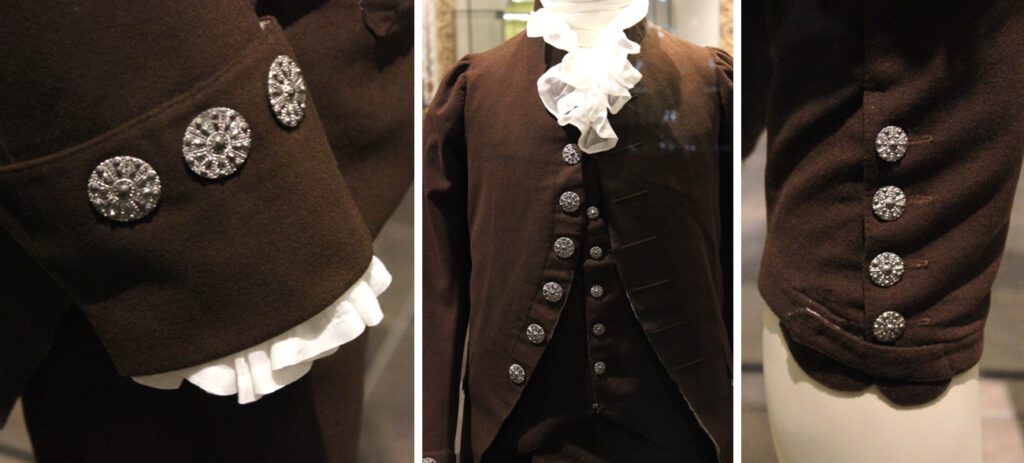
- The move towards informality meant that, in the 1770s, the single-breasted frock coat with a turned-down collar became standard dress for British men on most occasions, except at court. Double-breasted frock coats became more common in the 1780s.
- The full-dress coat, or habit à la française, remained in use. Matching three-piece suits continued to be worn, particularly by more conservative or older men.
- In general, coats became slimmer in cut, with side seams curving back and sleeves fitting more closely. The front skirts of coats were cut away, and the fullness of the side pleats was reduced, revealing more of the waistcoat and breeches. As a result, buttons and buttonholes extended only to the waist.
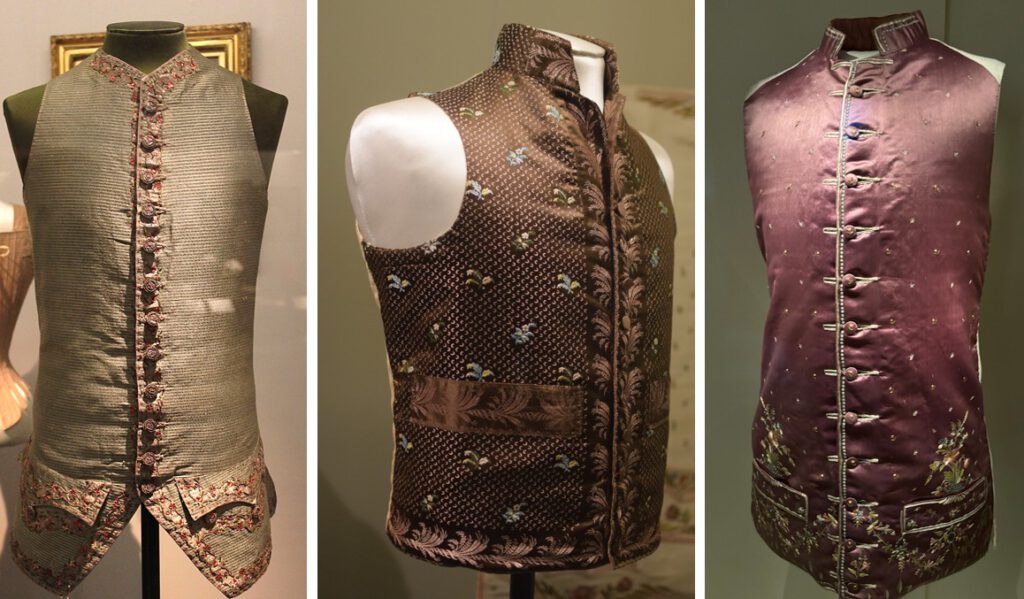
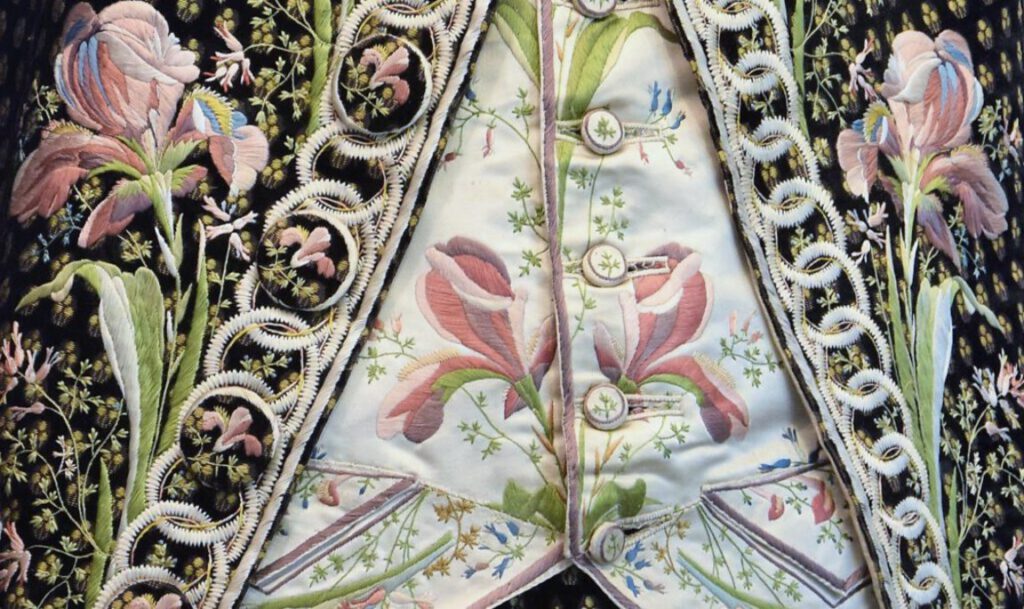
- Waistcoats became a focal point of dress in the 1780s. Often paired with plain coats and breeches, an elaborately decorated waistcoat signalled the wearer’s taste and awareness of current fashion.
- Stripes were especially fashionable throughout the 1780s, appearing on coats, waistcoats, and stockings.
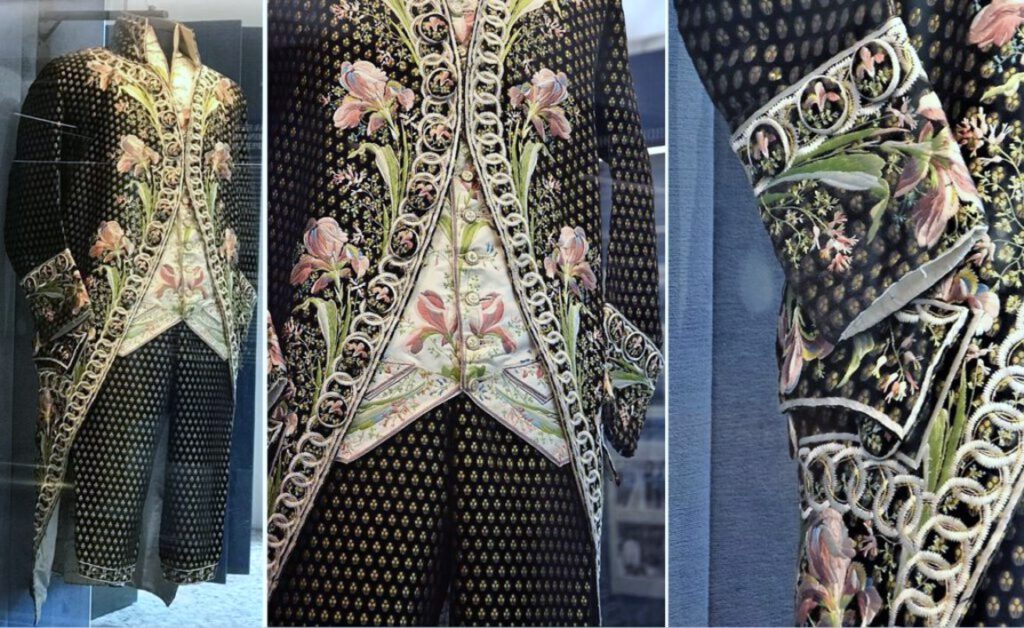
Highly formal dress continued to be worn at court. This typically consisted of a richly embroidered habit à la française, including coat and breeches, paired with a coordinating silk waistcoat adorned with motifs such as delicate floral sprays and bow knots. Velvet coats might be embellished with sparkling spangles. Formal suits generally featured a high standing collar, a single-breasted front, and the characteristic inverted-V shape seen in waistcoat skirts.
The Fashion Gallery
I have compiled a selection of photos for you, arranged to show the historical fashion items in chronological order in each section. Enjoy the beautiful garments!
Ladies, 1770s – 1780s

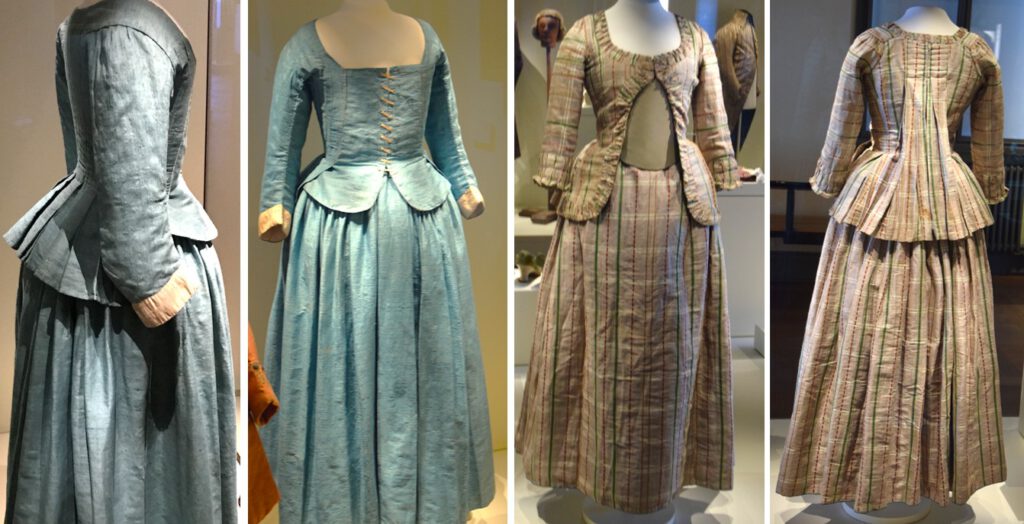
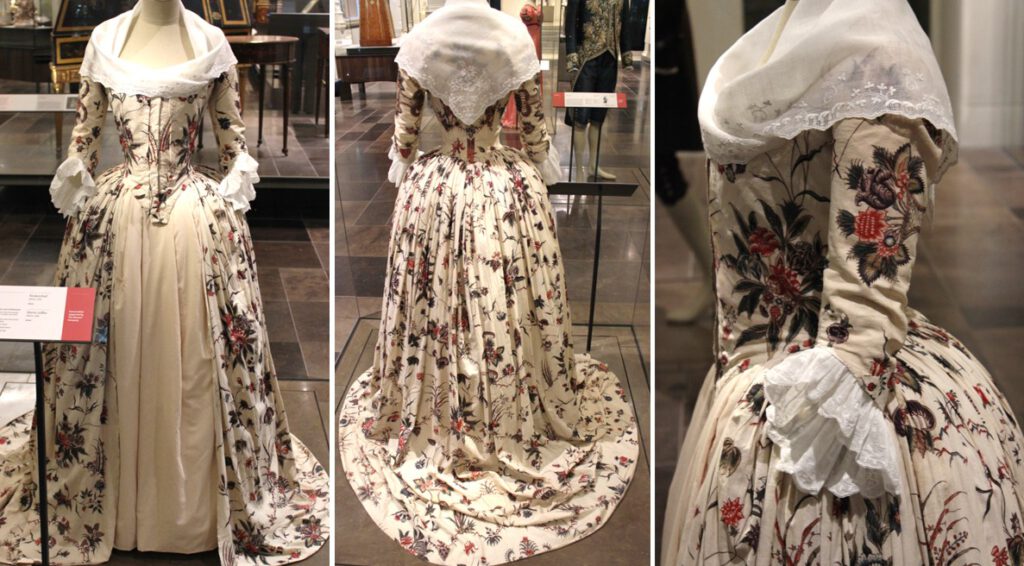
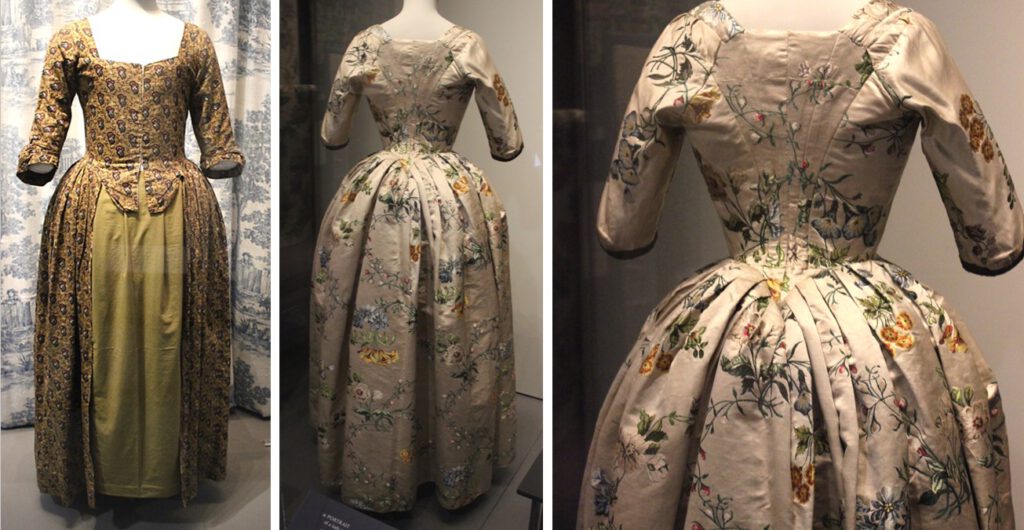

Gentlemen, 1770s – 1780s
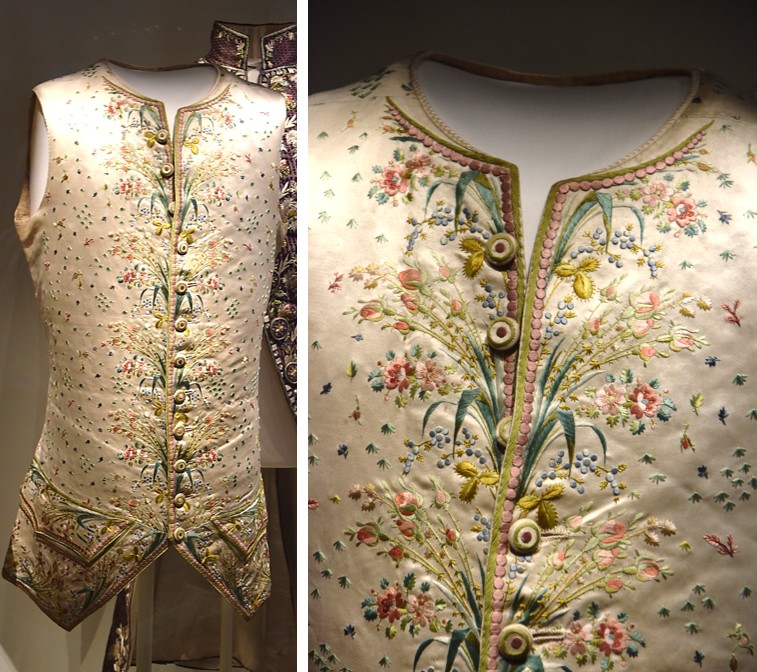
Related articles
Sources
- en.wikipedia.org/wiki/Polonaise_(clothing)
- en.wikipedia.org/wiki/Caraco
- Michele Majer: 1770-1779 at: Fashion History Timeline: https://fashionhistory.fitnyc.edu/1770-1779/
- Michele Majer: 1780-1789 at: Fashion History Timeline: https://fashionhistory.fitnyc.edu/1780-1789
- Cassidy Percoco: The Robe Parée, Mimic of Modes, March 18, 2012; https://mimicofmodes.com/2012/03/18/the-robe-paree/
- V & A Museum, Cromwell Road, London, SW7 2RL, UK
- Bayerisches Nationalmuseum, Prinzregentenstraße 3, 80538 Munich, Germany
- Bowes Museum, Newgate, Barnard Castle DL12 8NP, UK
- Bowood House, Old Rd, Derry Hill, Calne SN11 0LZ, UK
- Musée de la Compagnie des Indes de Lorient, Citadelle de Port-Louis,, Avenue du Fort de l’Aigle, 56290 Port-Louis, France
- Villa di Melzi, Napoleonic Museum, Bellagio / Como, Italy
- Germanisches Nationalmuseum, Kartäusergasse 1, 90402 Nürnberg, Germany
- Centre national du costume et de la scène, Quartier Villars, Route de Montilly, 03000 Moulins, France
Article by Anna M. Thane, author of the novel
“Von tadellosem Ruf” (http://amzn.to/2TXvrez)