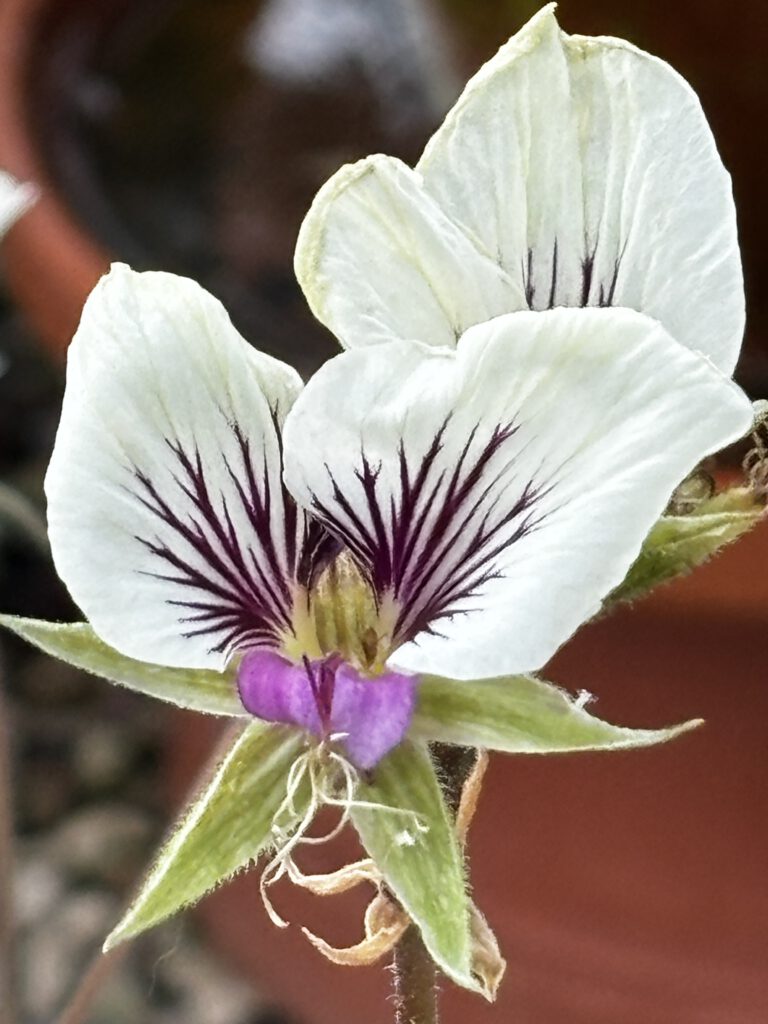
In her novels, Jane Austen uses plants to illustrate social hierarchies, character distinctions, and underlying themes. In this article, I examine a brief scene involving Fanny Price and her “geraniums” in Mansfield Park. I argue that Austen’s “geranium” is most likely a pelargonium—a plant commonly misnamed as a geranium—and that recognising this allows us to read the plant as a subtle symbol connected to slavery, a central concern of the novel.
Let us take a closer look at Fanny and her geranium:
“The East room, as it had been called ever since Maria Bertram was sixteen, was now considered Fanny’s,” (…) “To this nest of comforts Fanny now walked down to try its influence on an agitated, doubting spirit, to see if by looking at Edmund’s profile she could catch any of his counsel, or by giving air to her geraniums she might inhale a breeze of mental strength herself.”
(Jane Austen, Mansfield Park, chap. 16)
From this scene, we learn little about the plant. It belongs to Fanny, is kept indoors, and is occasionally placed where it has direct access to air, light, and perhaps the weather—a window sill, for example. We are not told about the colour of its petals, its height, or the shape of its leaves. To gather more clues, we must turn to the history of botany and to literary analysis of the novel.
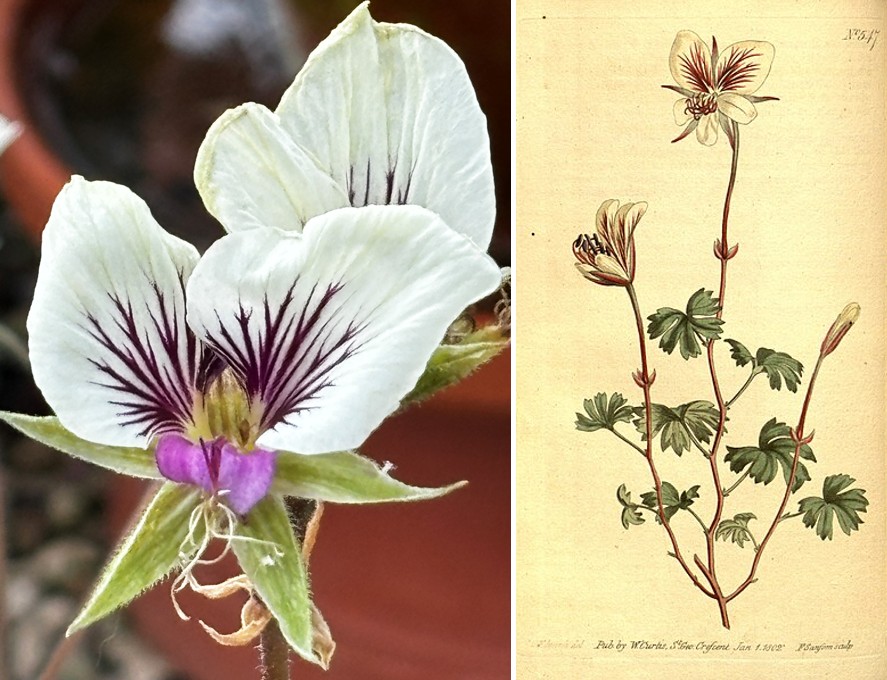
Who is who: Geraniums and pelargoniums
- Pelargoniums grow in South Africa. The first plants or seeds were introduced to the botanical garden in Leiden, in the Netherlands, before 1600. Some seeds reached the British gardener John Tradescant via Paris in 1632. As pelargoniums can tolerate only slight frost, they were considered greenhouse plants. They were rare and valuable during the early 18th century.
- Geraniums are wildflowers that grow in temperate climates. Several types of hardy geranium are native to Britain. Their common name is cranesbill, as the fruit capsule resembles a crane’s head and bill.
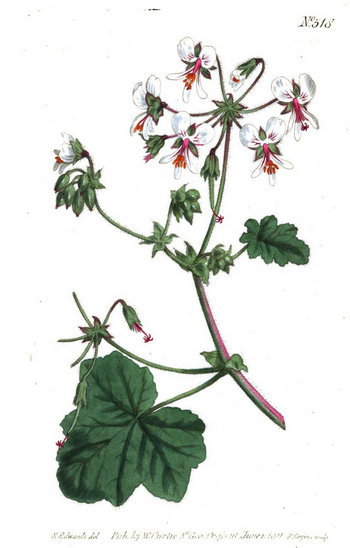
During the emergence of botany as a science, pelargoniums were long considered “geraniums” because of the resemblance of both their blossoms and fruit capsules. The name pelargonium for the South African plant was first proposed by the botanist Johann Jacob Dillenius (1684–1747) in 1732 and formally introduced by the physician and botanist Johannes Burman (1707–1780) in 1738. They were correct in recognising that pelargoniums form a different genus from geraniums. However, they had the misfortune that the leading authority in botany, Carl Linnaeus (1707–1778), disagreed and classified pelargoniums as geraniums in his major work of 1753. In the mid-18th century, Linnaeus’s opinion was generally considered authoritative.
It was not until 1792 that the French botanist Charles Louis L’Héritier de Brutelle (1746–1800), in his work Geraniologia, corrected Linnaeus’s error. Pelargoniums were reclassified—but the public had become so accustomed to calling the plant a geranium that the scientific distinction was largely ignored. Even today, pelargoniums are commonly referred to as geraniums.
A short introduction to the literary analysis of Mansfield Park as a novel about slavery
Mansfield Park, Jane Austen’s third published novel, was written between February 1811 and the summer of 1813, and published in May 1814. The novel has often been regarded unfavourably. It was not reviewed by many literary magazines of the time, and to this day its main character, Fanny Price, remains one of Austen’s least popular heroines. Yet it is arguably her most important ‘political’ novel, as its central theme is slavery.
For Austen’s contemporaries, the novel’s subject would likely have been apparent due to its allusions to the slave trade and its use of vocabulary associated with slavery. These references have become less obvious over time. It was in 1983 that scholar Margaret Kirkham connected the Mansfield Park estate with the Lord Chief Justice Lord Mansfield (William Murray, 1st Earl of Mansfield (1705 –1793). By ruling in 1772 that slavery was illegal on English soil, he moved the country onto the path to abolishing slavery. Margaret Kirkham also connected the character of Mrs. Norris to Robert Norris, a slave-ship captain.Though the topic of slavery is touched here and there openly in the novel, e.g. with Fanny asking about the slave trade and getting no reply, it is through detailed literary analysis that modern readers can understand that Mansfield Park is fundamentally concerned with slavery. Austen employs a range of symbols and allusions, as well as carefully chosen names, to convey this theme. Helena Kelly’s Jane Austen, the Secret Radical offers a comprehensive analysis.In her book, Kelly argues that the name “Norris” does not refer to Robert Norris but to Henry Handley Norris (1771–1850). He was a clergyman and theologian, who defended the connection to slavery of the Church of England. He also led the theological and political pressure group Hackney Phalanx. It was regarded as the rival and counterpoise of the evangelical school or “Clapham sect“, a group of social reformers campaigning for the abolition of slavery. Kelly further notes Austen’s use of pointed vocabulary such as plantation (5 times) and chains (13 times) to put images related to slavery in the mind of her readers. She also interprets the ‘Moor Park’ apricot tree, given to Mr and Mrs Norris by Sir Thomas Bertram, as a symbol of slavery. The term “moor” was historically used as a derogatory term for people from North Africa.According to Kelly, Mansfield Park critiques the shortcomings of church and society with regard to slavery: although the slave trade was abolished in 1807, slavery itself was not abolished until 1833.
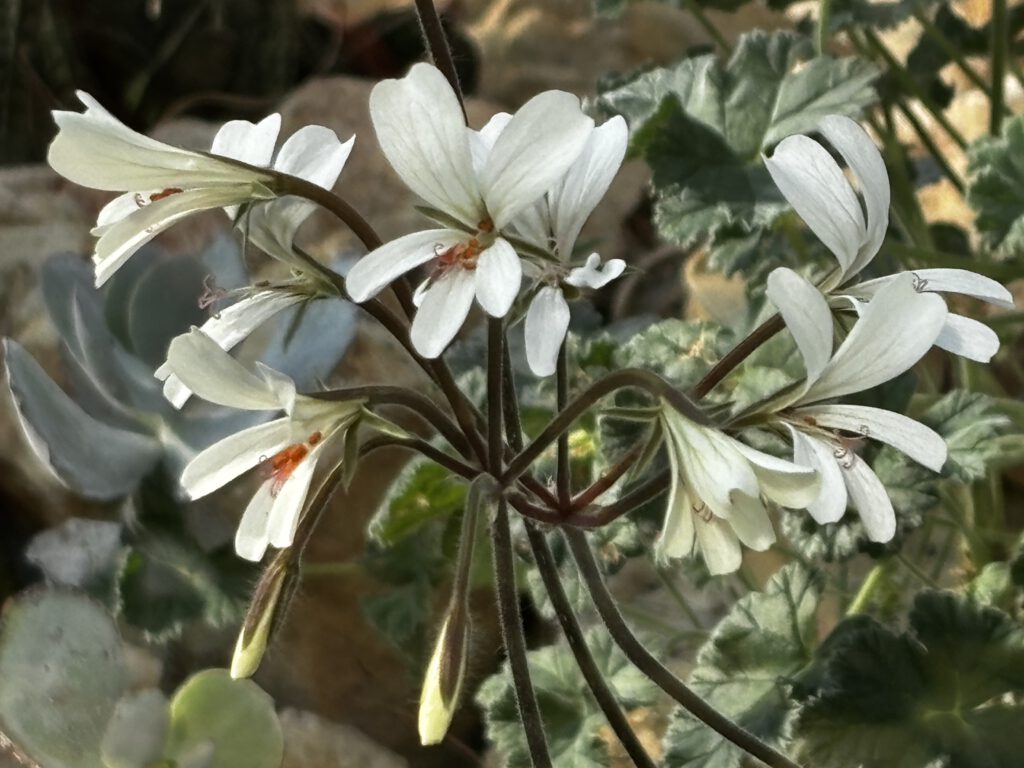
How does Fanny’s plant fits into this?
First, let us consider the timeline of the growing popularity of pelargoniums in Britain:
- As noted earlier, pelargoniums were rare and expensive during the early 18th century. The earliest specimens were cultivated in aristocratic gardens, such as the pelargonium grown by the royal gardener John Tradescant in the garden of Queen Henrietta Maria’s minor palace in Surrey around 1632.
- Even when Dutch botanist Paul Hermann collected life plants in South Africa in 1672 and grew them in the Leiden botanical garden, these were mainly shared among botanists. Pelargoniums remained rare for several decades, as they were considered to be plants for the greenhouse.
- They began to appear in more modest households around the 1780s, when they could be successfully grown indoors or in small conservatories. By 1783, the catalogue of the nurseryman John Conrad Loddiges, who specialised in exotic plants, already listed 37 species. Still, rarer varieties remained expensive, with prices as high as six guineas per plant in 1795. Less rare, but still highly desirable plants were sold for three guineas.
- However, as pelargoniums can easily be propagated from cuttings, it is reasonable to assume that prices for more common varieties declined rapidly. By 1801, The Botanical Magazine described Pelargonium tomentosum as very common. “Now every garret and cottage window is filled with numerous species of the beautiful tribe,” wrote the botanist Edward James Smith in the early 19th century.
By the time Austen was writing Mansfield Park, pelargoniums were widespread in British nurseries and homes, making it entirely plausible that Fanny Price could own one. Due to the popularity of botany during this time, it would also have been widely known that the “geranium” originated from Africa, which contributed to its appeal as an exotic plant.
The meaning of geraniums in Mansfield Park
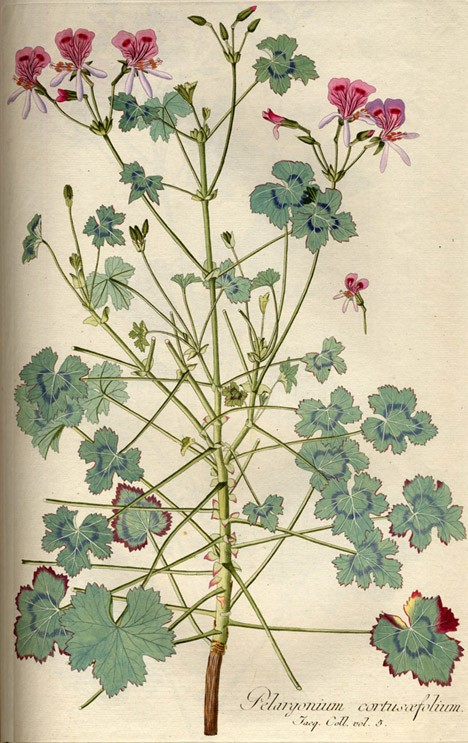
The role of geraniums in Mansfield Park has not been widely discussed. The scene itself is brief and notable more for what is not done with the plant than for what is. Fanny “airs” her geraniums to gain mental strength. This suggests that she places them briefly on a windowsill, perhaps in the sunshine—but only temporarily. They are then returned to her cold, uncomfortable room.
If the plant were a hardy, native geranium, one might interpret it as a symbol of Fanny herself: modest, unassuming, and occasionally granted small comforts. However, this reading seems overly simplistic for a novelist as sophisticated as Austen, and there would be no connection with many of the other symbols Jane used in the novel.
If, on the other hand, the plant is a South African pelargonium, its symbolism aligns more closely with interpretations of Mansfield Park as a critique of British society’s failure to abolish slavery. Austen has Fanny “air” the plant, but not plant it outside in a more suitable environment. The plant experiences only a fleeting suggestion of its natural conditions. This may allude to Britain having abolished the slave-trade in 1807 but not having ended slavery: Just as Fanny derives a sense of mental relief (or mental strength) from airing the pelargonium, society and church may be seen as taking satisfaction in the few steps taken against the brutal system of the slave trade. However, it was not until the Slavery Abolition Act of 1833 that slavery was finally abolished in the British Empire.
Mansfield Park concludes with Fanny marrying her cousin, clergyman Edmund Bertram, whom Austen portrays as a hypocrite. Although aware of the troubling origins of the Bertram family’s wealth—derived from their estate in Antigua—Fanny ultimately ceases to question it. She accepts life at the parsonage at Thornton Lacey, with access also to the Mansfield Park parsonage. Edmund’s income as a clergyman is provided by his father, Sir Thomas Bertram, the owner of a sugar plantation in the West Indies.
Recognising that Fanny’s “geranium” is in fact a pelargonium, and that Austen may be using it as a symbol of slavery, adds another piece to the puzzle of understanding Mansfield Park. It reinforces the interpretation of the novel as a critique of society’s and the Church’s failure to confront and dismantle the brutal system of slavery, while continuing to benefit from its profits.
Sources
- William Curtis: The Botanical Magazine; vol. 4, London: 1791
- Paula ‘Gardenhistorygirl’: “Pelargonium or Geraniums”, at: https://www.gardenhistorygirl.co.uk/post/geraniums-or-pelargoniums-on-the-windowsill, 11 July 2022
- Collins Hemingway: “Adjudicating Wiltshire’s Readings of Mansfield Park”, in: JASNA Publications, Volume 44, No 1 — Winter 2023 at: https://jasna.org/publications-2/persuasions-online/volume-44-no-1/hemingway/
- Helena Kelly: Jane Austen, the Secret Radical; 2016
- Conrad Loddiges: A cataloque of plants and seeds; London, 1783
- Dr David Marsh: The Garden History Blog: The Great Geranium Robbery; 2015, at: https://thegardenhistory.blog/2015/06/06/the-great-geranium-robbery/
- Dr David Marsh: The Garden History Blog: The Great Geranium Robbery… part 2…and other plant thefts; 2015, at: https://thegardenhistory.blog/2015/06/13/the-great-geranium-robbery-part-2-and-other-plant-thefts/
- Matija Strlic: “Brief History of the Genus”, at: https://www.pelargonium.si/history.html
- Molly Williams „Jane Austen’s Garden: A Botanical Tour of the Classic Novels“; 2025
- Kim Wilson: Auf den Spuren von Jane Austen: Die Schauplätze ihres Lebens und ihrer Romane; 2015
- Andrea Wulf: The Brother Gardeners: Botany, Empire and the Birth of an Obsession; Cornerstone, 2008
Related articles
Article by Anna M. Thane, author of the novel
“Von tadellosem Ruf” (http://amzn.to/2TXvrez)